Leave Your Message
0%

Choosing the right Metal Square Tubingmanufacturer in China isn't just about comparing prices, you know? There's a lot more to it. A trustworthy supplier should have solid production experience, deliver consistent quality, and communicate technical details clearly—none of that vague, confusing stuff. Keep in mind, Metal Square Tubing needs to fit your project perfectly — matching dimensions, wall thickness, steel grade, surface finish, and the load it’s supposed to handle. Even tiny mistakes can lead to big fitting issues when you’re fabricating everything together.

Look for manufacturers who have documented quality systems and modern production lines. Their factories should support everything from cutting and forming to welding, straightening, and surface treatments. An experienced team will be able to control things like the corner radius, dimensional tolerances, weld quality, and corrosion prevention. Plus, they should be able to provide Mill Test Certificates, inspection reports, sample approvals, and batch traceability—that stuff really helps you verify performance before your order ships out.

Seeing real proof in hand is super important.

A reliable supplier from China should be transparent about their process. Don't hesitate to ask about where they get their raw materials, the testing equipment they use, how they package products, or their experience with exports. Photos are helpful, but getting third-party inspections or certifications really boosts your confidence. No company is perfect, though. Even seasoned buyers might overlook tolerances shifting after galvanizing or powder coating. That's why having clear drawings and written specifications is so crucial. Good companies, especially those based in China, should be open to answering reasonable questions—that’s part of building trust. Remember, the biggest factory isn’t always the best partner. The right supplier is one who understands your needs, is honest about what they can do, and consistently delivers on time. This guide highlights what truly sets dependable manufacturers apart from those just throwing out shiny quotes.
China Best Metal Square Tubing Manufacturer and Supplier?

What Is Metal Square Tubing?

Metal square tubing is a hollow section with four flat sides and rounded outer corners. Its consistent geometry provides strength, clean lines, and easier alignment than many solid profiles. Contractors commonly use it for frames, handrails, equipment supports, gates, and light structural assemblies.

Tubing Steel is usually produced from carbon steel, Stainless Steel, or galvanized steel. The selected grade affects weldability, corrosion resistance, weight, and cost. Common specifications, such as ASTM A500, define mechanical and dimensional requirements for structural tubing. According to the World Steel Association’s World Steel in Figures 2024, global crude steel production reached about 1.89 billion tonnes in 2023. This scale supports broad availability, but quality still varies between mills and batches. In practice, I would inspect wall thickness, corner radius, straightness, and surface condition before fabrication. Small differences can complicate welding.

Tips: Measure the outside dimensions and wall thickness separately. Do not judge strength by appearance alone. Check the material certificate, grade, tolerance, and corrosion protection. For outdoor use, galvanized or coated tubing may last longer, though damaged coating needs repair. A square tube can also trap moisture inside. That detail is easy to miss. Think again about drainage holes, especially in exposed frames. A supplier should provide traceable test documents and cut samples when project risk is high. The honest limitation is simple: no single tube size fits every load, span, or environment.

How Is Metal Square Tubing Manufactured?

How Is Metal Square Tubing Manufactured?

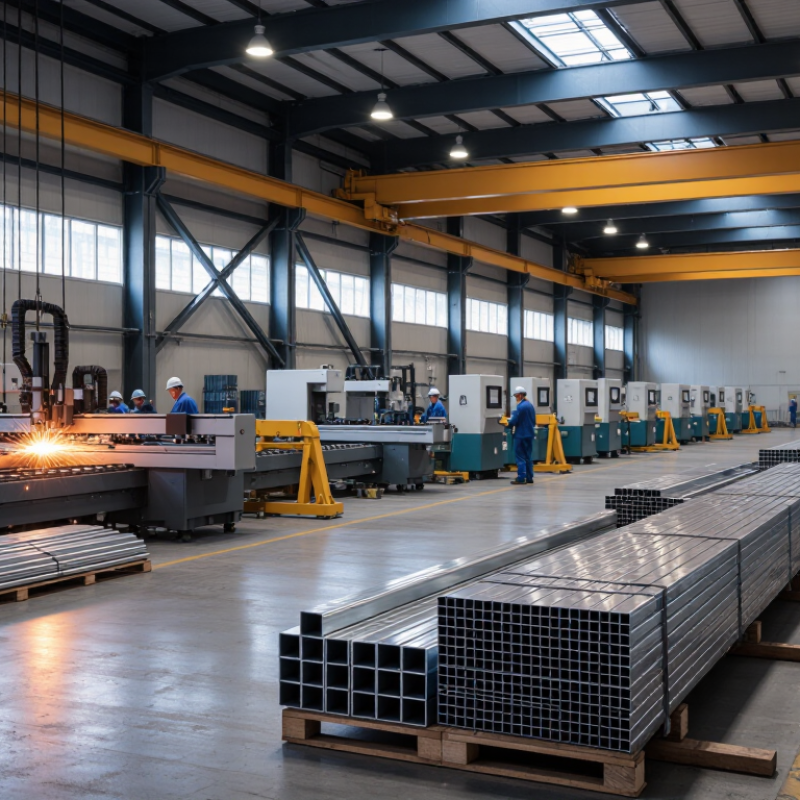
Metal square tubingusually starts with a large Steel Coil. The coil is unrolled, leveled, and slit into narrower strips.

The World Steel Association reported 1,892.2 million tonnes of crude steel production in 2023. That scale supports consistent raw-material supply, but it does not guarantee quality.

The strip passes through forming stands, which gradually bend it into a square profile. Its edges meet along one seam. High-frequency electric resistance welding then joins them without adding separate filler metal.

A sizing section corrects the corners and controls the outside dimensions. Flying saws cut the continuous tube into fixed lengths.

Small details matter here. Poorly adjusted rollers can create twist, uneven corners, or wall-thickness variation.

Quality teams inspect weld appearance, dimensions, straightness, and surface condition. Many structural products follow ASTM A500/A500M or comparable national standards.

These specifications define requirements for chemical composition, mechanical performance, and dimensional control. The International Energy Agency identifies efficiency improvements and greater scrap use as important routes for lowering steelmaking emissions.

Yet recycled feedstock can vary. A clean surface can still hide internal weakness, so visual inspection alone is not enough.

In practical production, sampling, hardness checks, tensile testing, and non-destructive weld evaluation provide stronger evidence. Manufacturers should also keep heat numbers and inspection records traceable from coil to finished tube.

Which Metals Are Used for Square Tubing?

When choosing a China-based metal square tubing manufacturer and supplier, metal selection should come first. Carbon steel is the most common option for structural frames, platforms, and machinery supports. The World Steel Association reported global crude steel production of about 1.89 billion tonnes in 2023. This scale supports broad availability and competitive pricing. ASTM A500 and EN 10219 are common references for structural hollow sections.

Aluminum square tubing suits lightweight assemblies, transport equipment, and corrosion-sensitive applications. The U.S. Geological Survey estimated global primary aluminum production at approximately 70 million tonnes in 2023. Aluminum is easier to handle, but its lower stiffness can require thicker walls or added bracing. Stainless steel offers stronger corrosion resistance in food-processing, coastal, and chemical environments. The International Stainless Steel Forum reported approximately 58.4 million tonnes of stainless steel production in 2023. Grades such as 304 and 316 remain widely specified. Yet, stainless steel costs more. Budget pressure matters.

Tips: Match the metal with load, moisture, temperature, and fabrication needs. Check wall thickness, outside dimensions, tolerances, and surface condition. Ask for mill test certificates and production inspection records. For welded structures, confirm the welding procedure and heat-affected-zone requirements. Galvanized carbon steel can reduce maintenance, but damaged zinc coatings need attention. A small caution: “corrosion-resistant” does not mean maintenance-free. Even good tubing can fail when drainage, weld quality, or design assumptions are overlooked.

China Best Metal Square Tubing Manufacturer and Supplier? - Which Metals Are Used for Square Tubing?

Metal or Alloy Common Grades and Standards Typical Chemical Composition Approximate Density Typical Yield Strength Main Advantages Common Square-Tubing Applications
Carbon Steel ASTM A500 Grade B or Grade C; ASTM A513 Iron-based alloy with carbon generally below 0.30%, plus small amounts of manganese and other elements About 7.85 g/cm³ Approximately 315–345 MPa High strength, good weldability, broad availability, and relatively low material cost Structural frames, machinery supports, trailers, fences, racks, agricultural equipment, and general fabrication
Galvanized Carbon Steel ASTM A500 structural tubing with zinc coating; ASTM A53 is also used for some tubular products Carbon-steel tube protected by a zinc coating, commonly applied by hot-dip galvanizing About 7.85 g/cm³ for the steel substrate Usually comparable to the underlying steel grade Improved resistance to atmospheric corrosion; zinc provides barrier and sacrificial protection Outdoor structures, guardrails, agricultural buildings, handrails, sign supports, and utility frameworks
Stainless Steel 304 ASTM A554; ASTM A312 for certain stainless tubular products Typically about 18% chromium and 8% nickel, with low carbon in 304L About 8.00 g/cm³ Approximately 205 MPa for annealed material Good general corrosion resistance, clean appearance, formability, and weldability Food-processing equipment, architectural frames, indoor railings, enclosures, and light industrial structures
Stainless Steel 316 ASTM A554; ASTM A312 for certain stainless tubular products Typically about 16–18% chromium, 10–14% nickel, and 2–3% molybdenum About 8.00 g/cm³ Approximately 205 MPa for annealed material Better resistance to chlorides and many chemicals than 304 stainless steel Marine environments, chemical-processing equipment, coastal structures, pharmaceutical facilities, and hygienic applications
Aluminum 6061-T6 ASTM B-221; ASTM B-429 for structural aluminum tubing Aluminum alloy containing approximately 0.8–1.2% magnesium and 0.4–0.8% silicon About 2.70 g/cm³ Approximately 240–276 MPa, depending on product form Low weight, good strength-to-weight ratio, natural oxide protection, and good machinability Transport equipment, lightweight frames, display systems, platforms, solar structures, and recreational equipment
Aluminum 6063-T5 or T6 ASTM B-221; commonly used for architectural extrusions Aluminum alloy with magnesium and silicon, optimized for extrusion and surface finishing About 2.70 g/cm³ Approximately 145–214 MPa, depending on temper Excellent extrudability, smooth surface, good corrosion resistance, and attractive anodized finish Architectural frames, partitions, furniture, shop fittings, light-duty enclosures, and decorative structures
Copper ASTM B75 or ASTM B88 for applicable copper tube products Usually at least 99.9% copper for commercially pure grades About 8.96 g/cm³ Approximately 70–220 MPa, depending on temper Very high electrical and thermal conductivity, good corrosion resistance, and easy joining Electrical busbars, heat-transfer assemblies, architectural details, grounding components, and specialty fabrication
Brass ASTM B135 and other copper-alloy specifications Copper-zinc alloy, commonly containing approximately 60–70% copper About 8.4–8.7 g/cm³ Approximately 100–300 MPa, depending on alloy and temper Good machinability, attractive appearance, moderate corrosion resistance, and useful wear properties Decorative frames, hardware, instrument components, furniture parts, and specialty architectural tubing
Note: Mechanical values are typical reference ranges for common product conditions. Actual properties depend on alloy grade, temper, manufacturing method, wall thickness, heat treatment, and the applicable standard.

What Are the Main Applications of Metal Square Tubing?

What Are the Main Applications of Metal Square Tubing?

Metal square tubing is widely used where strength, clean geometry, and easy fabrication matter. Construction remains its largest field. The World Steel Association reports that buildings and infrastructure consume about half of Global Steel demand. Square tubing appears in columns, roof frames, handrails, gates, and temporary supports. Its four flat sides simplify welding and connection design.

Manufacturing uses it for machine frames, conveyor supports, workstations, and protective guards. In transport equipment, tubing helps form lightweight chassis and trailer structures. Furniture makers also use smaller sections for tables, shelving, and display fixtures. Cold-hardened metal coil can support efficient production when manufacturers need consistent thickness and repeatable forming. However, “stronger” is not always better. Excess hardness may complicate bending or increase cracking risk.

Tips: Check the grade, wall thickness, outside dimensions, and corrosion protection before ordering. ASTM A500 and EN 10219 are common reference standards, but project requirements still control. Inspect weld zones, corner radius, and straightness during receiving. The American Iron and Steel Institute notes that structural performance depends on section properties, connections, and loading conditions—not material strength alone. A practical supplier should provide mill test reports, dimensional data, and traceability. Yet small projects often skip these checks. That can create costly rework later.

Main Applications of Metal Square Tubing

Square tubing is widely used in construction frames, machinery, automotive structures, furniture, and infrastructure. The chart shows representative wall thicknesses commonly selected for these applications. Actual dimensions depend on structural loads, corrosion conditions, fabrication requirements, and applicable standards such as ASTM A500 or EN 10219.

How to Evaluate a Square Tubing Manufacturer?

China Best Metal Square Tubing Manufacturer and Supplier?

How to Evaluate a Square Tubing Manufacturer?

Evaluating a square tubing manufacturer requires more than comparing prices. Check the factory’s production equipment, inspection process, and material traceability. Ask for mill certificates, dimensional reports, and coating test records. Reliable suppliers can explain steel grades, wall thickness tolerances, welding methods, and surface treatments clearly.

Look closely at sample tubing. Measure the outside dimensions, corner radius, wall thickness, and straightness with suitable tools. A good sample should have clean welds, consistent corners, and no visible cracks or deep scratches. Request samples from actual production, not specially prepared pieces. This small detail can reveal process stability.

Communication matters during technical discussions. The manufacturer should answer questions with drawings, data, and realistic delivery schedules. Ask how rejected materials are separated and how complaints are handled. Experienced corrosion-resistant metal suppliers usually provide batch identification and quality records. However, certificates alone are not enough. I have seen documents look complete while packaging failed to protect the tubing from moisture. Inspect packing methods, loading photos, and storage conditions. A factory audit can expose weaknesses that online conversations miss. The evaluation may still be imperfect, especially when production changes between orders. That risk deserves attention.

What Makes a Reliable Metal Square Tubing Supplier?

A reliable metal square tubing supplier proves consistency before discussing price. The World Steel Association reported nearly 1.89 billion metric tons of crude steel production worldwide in 2023. That scale makes traceability essential. Ask for heat numbers, chemical certificates, dimensional records, and coating thickness results. A dependable supplier can connect each bundle to its mill documentation. The tube should arrive straight, clean, and properly packed. Small dents can become serious fitting problems on site. Measure the outside dimensions, wall thickness, corner radius, and length tolerance against the agreed specification.

Material protection also reveals supplier discipline. The IMPACT study by NACE estimated global corrosion costs at approximately 3.4% of worldwide gross domestic product. Hot-dip galvanizing can reduce maintenance exposure, but coating quality must be verified rather than assumed. Hot-Dip Galvanized Metal Suppliers should provide coating mass or thickness data, surface inspection records, and handling guidance. Ask how they manage uncoated edges, drainage holes, and storage moisture. These details affect service life. Production capacity matters, yet stable delivery matters more. A supplier may quote thousands of tons, but can they repeat the same tolerance next month? That question is uncomfortable. It should still be asked. Experienced buyers also inspect sample cuts, weld appearance, bundle labels, and delivery packaging before approving larger orders. No certificate replaces physical inspection.

FAQS

What is metal square tubing?

Metal square tubing is a hollow profile with four flat sides and rounded outside corners. It provides strength, alignment, and clean lines. Common uses include frames, handrails, gates, equipment supports, and light structural assemblies.

Which metals are commonly used for square tubing?

Common options include carbon steel, stainless steel, and galvanized steel. Each choice affects weldability, corrosion resistance, weight, and cost. The cheapest option is not always the most suitable.

What should be checked before fabrication?

Check outside dimensions, wall thickness, corner radius, straightness, and surface condition. Review the material grade, tolerance, certificate, and corrosion protection. Appearance alone cannot prove strength.

How is square tubing manufactured?

Production usually begins with a large steel coil. The coil is unrolled, leveled, and slit into narrower strips. Forming stands gradually bend the strip into a square shape. The edges meet along one seam.

How is the seam joined?

High-frequency electrical resistance welding joins the edges. It normally uses no separate filler metal. Sizing equipment then controls the corners and outside dimensions. Poor roller adjustment can cause twisting or uneven corners.

How is the finished tubing cut and inspected?

Flying saws cut the continuous tube into fixed lengths. Inspectors check weld appearance, dimensions, straightness, and surface condition. Sampling, hardness checks, tensile tests, and weld evaluations provide stronger evidence than visual inspection alone.

Is galvanized square tubing suitable for outdoor use?

Galvanized or coated tubing may last longer outdoors. However, damaged coating needs prompt repair. Moisture can also collect inside the hollow section. Drainage holes may be necessary in exposed frames.

Can one square tube size handle every project?

No. Load, span, wall thickness, metal grade, and environment all matter. A tube that looks strong may still fail under unsuitable conditions. I would check calculations and test documents before high-risk fabrication. The first choice may be wrong.

Conclusion

Metal Square Tubing is a hollow structural profile with four equal sides, valued for its balanced strength, clean appearance, and efficient use of material. This article explains how it is produced through forming, welding, sizing, cutting, and surface treatment, while introducing common material options such as carbon steel, stainless steel, aluminum, and galvanized steel. Each metal offers different advantages in strength, corrosion resistance, weight, cost, and suitability for specific environments.

The article also reviews major applications, including construction frames, machinery, transportation equipment, furniture, agricultural systems, and architectural structures. To evaluate a square tubing manufacturer, buyers should consider production capabilities, material control, dimensional accuracy, testing procedures, certifications, customization options, and delivery performance. A reliable Metal Square Tubing supplier should provide consistent quality, clear technical communication, stable production capacity, responsive service, secure packaging, and dependable after-sales support. Selecting a supplier based on both product performance and long-term reliability helps ensure safe, efficient, and cost-effective project results.
Ethan

Ethan

Ethan is a skilled marketing professional at Guangzhou Chengxin Metal Co., Ltd., a premier provider of value-added steel processing and distribution services established in 2018 in the vibrant coastal city of Guangzhou, Guangdong Province. With a deep understanding of the steel industry and a......
Previous What Is Metal Square Tubing Used For?